Nigeria Sinotruk Local Sales Center 2025 Howo New Model
Top One World Famous Brand - Sinotruk Nigeria
Nigeria Sinotruk Local Sales Center 2025 Howo New Model
1. Why Choose a Stainless Steel Tanker Trailer for Sale in Nigeria?
2. Stainless Steel Tanker for Sale: Available Capacities and Specifications
3. Stainless Tanker Trailer for Sale for Different Liquid Transportation Needs
4. How to Choose the Right Stainless Steel Tanker for Sale in Nigeria
5. Get a Quote for a Stainless Steel Tanker Trailer from TITAN
A stainless steel tanker trailer is a practical choice for Nigerian transport companies that need reliable liquid transportation, corrosion resistance, and easier tank cleaning. For businesses transporting edible oils, food-grade liquids, and compatible chemical products, choosing the right stainless steel tanker for sale can help protect cargo quality, improve fleet flexibility, and support long-term operating efficiency.
Nigeria has a wide range of liquid transportation requirements, from supplying food-processing facilities and industrial manufacturers to moving liquid products between warehouses, distribution centres, and production sites. Transport operators need tankers that match their cargo, delivery routes, loading facilities, and daily operating schedules. A well-configured stainless tanker trailer for sale can help businesses meet these requirements while maintaining consistent transportation performance.
TITAN provides stainless steel tanker trailers with configurable tank capacities, compartment layouts, running gear, and discharge systems. Rather than choosing a trailer based on appearance or capacity alone, Nigerian buyers should consider the type of liquid being transported, the required material grade, and the conditions under which the tanker will operate.
Corrosion Resistance for Long-Term Transportation
One of the main advantages of a stainless steel tanker is its resistance to corrosion. Stainless steel contains chromium, which forms a protective oxide layer on the metal surface. When the selected grade is compatible with the transported liquid and the tanker is properly maintained, this protective layer helps reduce corrosion and supports a longer service life.
This characteristic is particularly valuable for businesses transporting certain food ingredients, edible oils, and industrial liquids. However, stainless steel is not resistant to every chemical under every condition. Chemical concentration, temperature, chloride content, and exposure time can all affect material compatibility. Buyers transporting specialised chemicals should confirm the appropriate stainless steel grade with the manufacturer before placing an order.
For Nigerian fleet operators, the objective is to select a tank body that suits the actual cargo rather than simply purchasing the highest-priced material option. TITAN can discuss the intended application and recommend a suitable configuration based on the product being transported.
Easier Cleaning and Better Cargo Hygiene
A properly finished stainless steel tank interior can be easier to clean than an unsuitable or deteriorating internal surface. This is important when transporting edible oil, milk, food ingredients, or other liquids that require controlled hygiene conditions.
For food-related applications, the material alone does not make a tanker food-grade. The internal finish, weld quality, seals, valves, hoses, cleaning procedures, and previous cargo history must also be considered. A tanker intended for food-grade service should be configured specifically for that purpose.
For example, an operator transporting palm oil between processing facilities in Nigeria may prioritise a smooth internal finish, suitable discharge equipment, and convenient access for inspection and cleaning. A business handling industrial chemicals may instead need to focus on chemical compatibility, sealing materials, and the correct unloading arrangement.
Selecting the appropriate design at the beginning helps reduce the risk of cargo contamination and unnecessary maintenance.
A Flexible Solution for Different Liquid Cargoes
A stainless tanker trailer for sale can be configured for several liquid transportation applications, provided the tank material and equipment are suitable for the intended cargo.
For Nigerian buyers, possible applications include edible oils, palm oil, selected food-processing liquids, milk, compatible industrial chemicals, and other liquids approved for the specific tank configuration. The correct design depends on the properties of the cargo and the operating requirements of the customer.
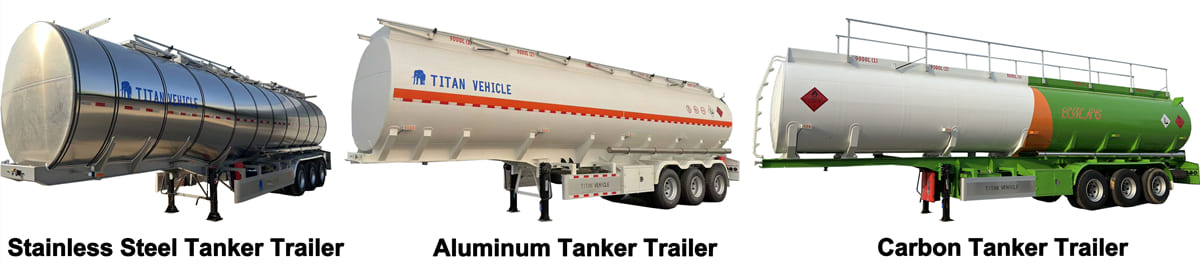
A stainless steel tank may also be considered for certain fuel or petroleum-related applications, but the decision should not be based on material alone. The design must meet the applicable requirements for the specific product, including any necessary hazardous-goods equipment and operating approvals. In some cases, a carbon steel or aluminium tanker may be more economical or more appropriate.
The key advantage of working with a manufacturer is the ability to compare material options before committing to a purchase. This allows transport businesses to balance purchase cost, durability, cargo requirements, and maintenance expectations.
Suitable for Nigerian Transport Operations
A tanker operating in Nigeria may travel between ports, industrial zones, processing plants, storage facilities, and regional distribution centres. Its performance depends on more than the tank body. Axles, suspension, tyres, braking equipment, chassis strength, landing gear, and coupling components all contribute to safe and dependable operation.
Buyers should also consider the routes on which the trailer will operate. A vehicle used for frequent long-distance transport may require a different specification from one working mainly between nearby industrial facilities. Road conditions, turning space, loading-site access, payload limits, and tractor-head compatibility should all be reviewed before finalising the design.
TITAN can configure a stainless steel tanker for sale according to the customer's intended operation, with options for tank capacity, compartments, axle arrangements, and other components subject to the final engineering specification.
For Nigerian buyers who want a tanker that fits their business rather than a generic standard model, discussing these details before production is an important step.
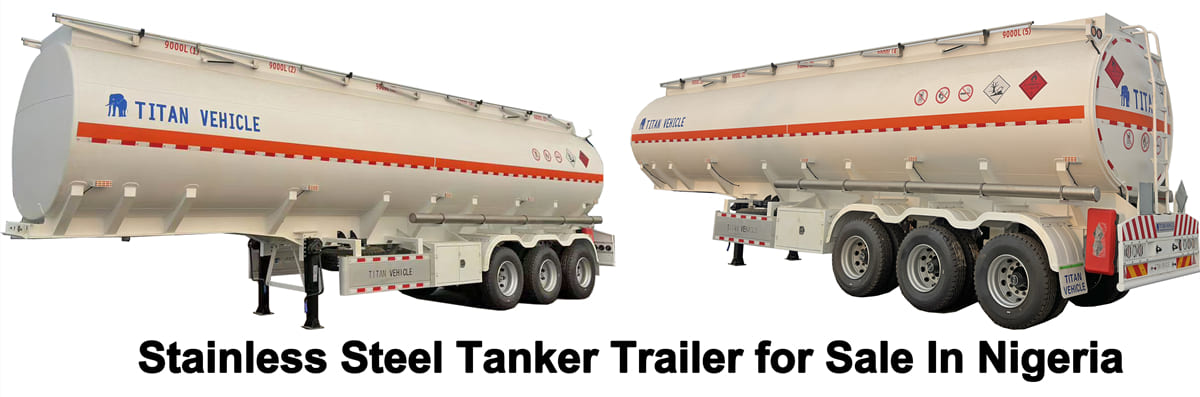 Why Choose a Stainless Steel Tanker Trailer for Sale in Nigeria?
The right stainless steel tanker for sale should provide enough usable capacity for the customer's cargo while remaining compatible with the tractor head, road restrictions, loading facilities, and delivery requirements. Capacity alone does not determine transportation efficiency. Tank dimensions, gross vehicle weight, axle configuration, compartment arrangement, and unloading speed must also be considered.
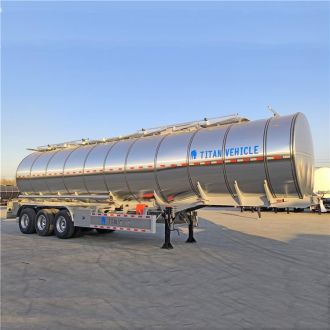
TITAN offers stainless steel tanker trailer configurations based on customer requirements. A 45,000-litre model is one example for buyers seeking a large-capacity solution, while other capacities and layouts can be discussed according to the intended application and engineering feasibility.
Different transportation businesses require different tanker capacities. A larger tank may help reduce the number of trips required for a given volume of cargo, but it also needs to comply with applicable weight and dimensional limits. A smaller tank may be more suitable for restricted delivery locations, lower-volume contracts, or operations that require greater flexibility.
Actual usable capacity, permissible payload, overall dimensions, and axle loads depend on the final design and operating conditions. Buyers should not assume that a larger tank can always carry more cargo legally or economically.
When requesting a quotation, Nigerian customers should specify the desired capacity in litres, the type of liquid, the expected loading volume, and the tractor head that will tow the trailer. This information allows the manufacturer to evaluate a suitable configuration instead of quoting a tank size in isolation.
For businesses that require substantial liquid-carrying capacity, a 45,000-litre stainless steel tanker trailer can be a useful option to evaluate.
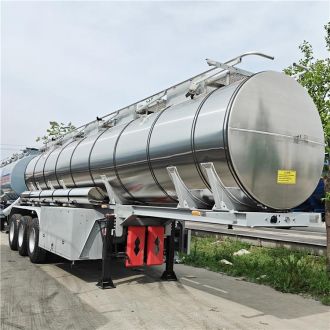
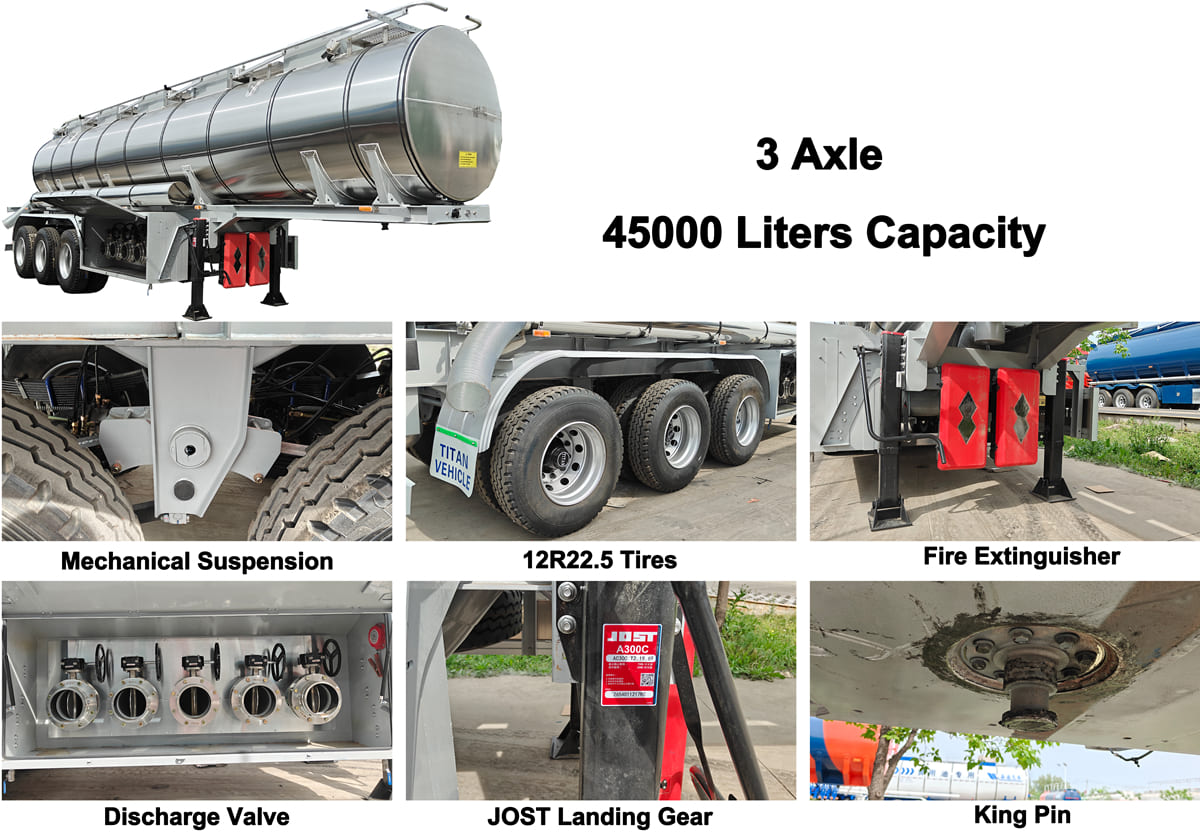
TITAN lists a 45,000-litre stainless steel tanker trailer configuration with three 13-tonne axles, five compartments, mechanical suspension, and a JOST 28-tonne landing gear option. The listed model provides a reference point for customers considering a multi-compartment tanker for compatible liquid cargoes.
The final specification must be confirmed against the intended cargo and operating requirements. In particular, tank material grade, tank-wall thickness, compartment volumes, valves, and any heating or insulation requirements should be established before production.
Single-Compartment or Multi-Compartment Tanker?
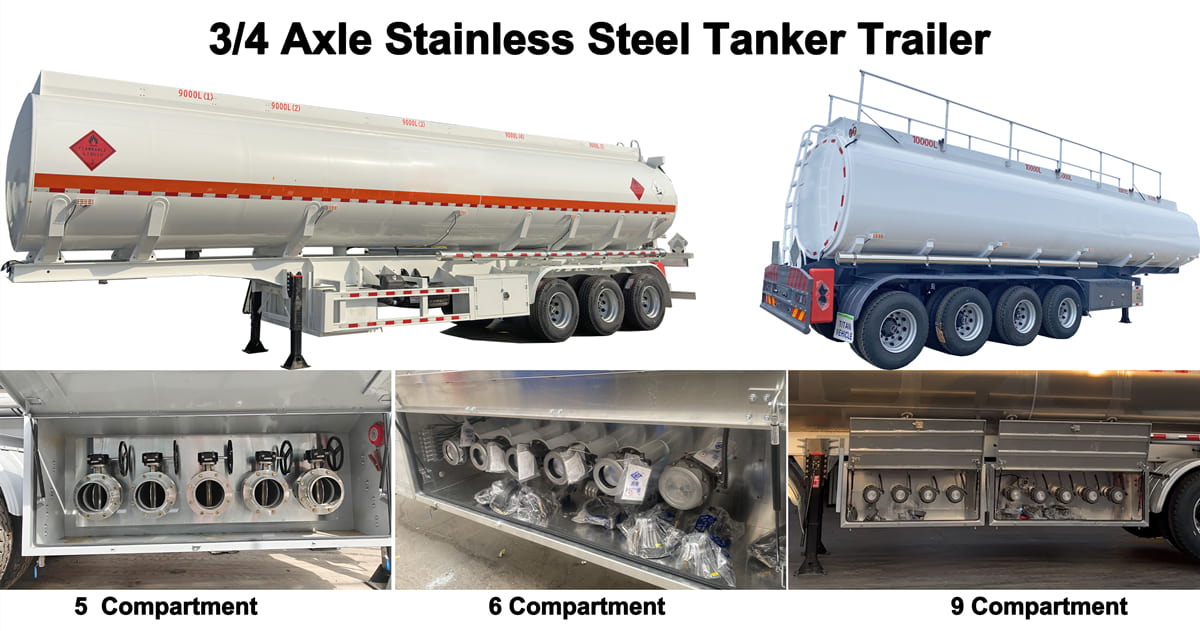
The number of compartments affects how a tanker can be used. A single-compartment design may be suitable for transporting one type of liquid in a full load, while a multi-compartment tanker may allow different compatible products or separate batches to be carried independently.
For Nigerian distributors supplying several customers along a route, multiple compartments can provide greater delivery flexibility. For example, a tanker carrying edible oil may be divided into separate sections to accommodate different delivery quantities, provided the cargo and unloading arrangements are suitable.
However, compartments do not automatically make a tanker suitable for carrying unrelated liquids. Each product must be compatible with the tank materials, seals, and cleaning procedures. The operator must also ensure that loading, unloading, and transport arrangements comply with applicable requirements.
The compartment layout should therefore be designed around the actual business model. Buyers should confirm the number of compartments, the volume of each section, the position of manholes, and the discharge-valve arrangement before ordering.
Tank Material and Construction
The correct material grade is one of the most important decisions when purchasing a stainless tanker for sale. Stainless steel grades differ in their resistance to corrosion, chemical exposure, and specific operating conditions.
Grade 304 stainless steel is widely used in many food-processing and general industrial applications, while Grade 316 or 316L may be considered where greater resistance to certain corrosive environments is required. Neither grade is universally suitable for every chemical, so compatibility should be checked against the exact cargo composition and operating temperature.
Tank construction also involves the shell, end plates, internal baffles, welds, supports, and connections. These components must work together to contain the liquid and withstand normal operating loads. The required thickness depends on engineering calculations, tank geometry, material properties, and applicable design requirements rather than a single universal measurement.
For a tanker intended for food-grade service, the interior finish and cleanability are also important. For chemical applications, the tank design must be evaluated alongside seals, valves, gaskets, and unloading hoses.
Nigerian buyers should request a detailed specification sheet showing the agreed material grade, relevant thicknesses, tank capacity, compartment arrangement, and accessory configuration.
Axles, Suspension, Tyres, and Coupling Equipment
A stainless steel tanker trailer is a complete semi-trailer system, not simply a tank mounted on wheels. Its running gear must be selected to match the finished vehicle weight, expected cargo load, tractor head, and operating environment.
Three-axle configurations are common in many tanker applications, but the appropriate axle arrangement depends on the final design and permitted loading conditions. Buyers should check axle ratings, tyre load capacity, braking performance, suspension, kingpin compatibility, and landing gear before confirming the order.
Mechanical suspension may be suitable for many conventional transportation operations. Other suspension arrangements may be considered where the route, payload, cargo characteristics, or operating preferences justify them.
The landing gear must support the disconnected trailer under the specified conditions, while the kingpin must match the tractor head's fifth-wheel system. Incorrect compatibility can lead to avoidable operational problems even when the tank itself meets the buyer's expectations.
For operations in Nigeria, it is also sensible to consider the availability of replacement tyres, brake components, suspension parts, and other service items. The lowest initial quotation may not represent the best value if routine maintenance becomes difficult.
 Stainless Steel Tanker for Sale: Available Capacities and Specifications
A stainless tanker trailer for sale should be selected according to the liquid it will carry, its required cleanliness level, and the conditions under which it will be loaded, transported, and discharged. There is no single tanker configuration that is ideal for every liquid. Matching the material and equipment to the cargo is the foundation of a practical purchase.
For Nigerian businesses, the most relevant applications may include edible oils, food-processing liquids, selected chemicals, and other compatible industrial liquids. The final suitability of any tanker must be confirmed for the actual product.
Stainless Steel Tankers for Edible Oil and Palm Oil
Edible oil transportation is one potential application for a properly configured stainless steel tanker. Nigeria has businesses involved in palm oil production, processing, storage, distribution, and food manufacturing, and these operations may require bulk-liquid transportation between facilities.
A tanker used for palm oil or other edible oils should be designed to maintain cargo quality throughout the journey. The material must be suitable for contact with the product, and the interior should be accessible for inspection and effective cleaning. Valves, seals, hoses, and discharge connections must also be appropriate for food-related use.
A smooth interior finish can help reduce areas where residues accumulate, making cleaning more manageable. Where the operating process requires it, buyers may also consider suitable cleaning-in-place arrangements or other approved cleaning procedures.
Temperature control should be considered when the cargo's physical properties require it. Some oils become more viscous or begin to solidify at lower temperatures. If a particular product requires heating or insulation to maintain flow, the tanker must be designed accordingly.
For Nigerian palm oil distributors, the most useful configuration will depend on the volume transported per trip, delivery frequency, loading equipment, discharge arrangements, and cleaning requirements.
Tankers for Food-Grade Liquid Transportation
Businesses transporting milk, food ingredients, and other liquids intended for human consumption need to pay particular attention to hygiene. A stainless steel tank can be an appropriate starting point, but the completed tanker must be designed for the relevant food-grade application.
The material grade should be compatible with the liquid, and all product-contact surfaces should be suitable for the required cleaning and sanitation process. Welds, joints, manholes, gaskets, and discharge equipment must be considered as part of the complete system.
Previous cargo history is also important. A tanker that has carried industrial chemicals cannot simply be assumed suitable for food transportation after an ordinary rinse. Dedicated equipment or validated cleaning procedures may be necessary to prevent contamination.
For customers in Nigeria supplying food manufacturers, processors, and distributors, the tanker specification should be based on the hygiene standards required by the cargo owner and the applicable regulations. Where relevant, buyers should confirm the documentation and material declarations needed for their operation.
TITAN can discuss the required tank finish, cleaning access, valves, and other design details with customers planning to transport food-grade liquids. The final configuration should be approved for the intended cargo before production begins.
Stainless Tankers for Compatible Industrial Chemicals
Certain industrial liquids require a tank material with good corrosion resistance. Depending on their chemical properties, some may be transported in stainless steel tankers, while others may require a different stainless steel grade, a protective lining, or an alternative tank material.
Chemical compatibility must never be determined from the product name alone. Concentration, temperature, impurities, and exposure time can affect the behaviour of a chemical in contact with stainless steel. Some substances can attack stainless steel under particular conditions even when the material performs well in other applications.
The complete fluid-handling system must also be considered. A tank may use an appropriate steel grade while its seals, gaskets, hoses, or valves remain unsuitable for the cargo. These components can become weak points if their chemical compatibility is overlooked.
For Nigerian industrial suppliers, a suitable stainless tanker trailer may support transportation between chemical manufacturers, storage terminals, factories, and industrial customers. Before ordering, the buyer should provide the product's technical data sheet or safety data sheet, where available, along with the normal concentration and operating temperature.
This allows the manufacturer to evaluate the application and identify the material and equipment requirements. If stainless steel is not suitable, selecting a different design is safer and more economical than attempting to solve a compatibility problem after delivery.
Tankers for Other Compatible Liquid Products
A stainless tanker for sale may also be considered for other liquids where the material and equipment are appropriate. Potential applications include certain industrial process liquids, selected water-related uses, and other bulk-liquid products.
However, these applications do not all share the same design requirements. Industrial water may have different requirements, depending on its chemical composition and end use. Liquids that contain corrosive salts or aggressive cleaning agents may also require additional material checks.
The same principle applies to petroleum-related liquids. Although stainless steel may be suitable for some specific products and conditions, buyers should compare it with carbon steel and aluminium options before deciding. A purpose-built fuel tanker may offer a more economical configuration for conventional fuel transportation, depending on the applicable specifications and operating rules.
The best stainless steel tanker trailer is therefore the one that matches the cargo, not necessarily the one with the greatest capacity or the most expensive material.
How the Tanker Design Affects Daily Operations
The design of a tanker influences more than its ability to carry liquid. It also affects loading time, unloading efficiency, cleaning, routine inspections, and vehicle availability.
For example, a poorly matched discharge arrangement may require additional time at the delivery point. An unsuitable compartment layout can complicate delivery scheduling, while difficult cleaning access may increase downtime between loads. Selecting the correct accessories at the purchasing stage helps reduce these avoidable problems.
Buyers should consider how the tanker will connect to existing loading and unloading equipment. The position and size of discharge outlets, hose connections, manholes, and valves should match the facilities used by the transport company and its customers.
The operator should also establish a maintenance schedule covering tyres, brakes, suspension, lights, coupling equipment, tank fittings, valves, and signs of leakage or corrosion. For food-grade applications, cleaning and inspection records should be maintained as required by the operating procedure.
A carefully specified stainless tanker trailer for sale can support a more consistent transportation process, provided it is operated within its design limits and maintained appropriately.
 Stainless Tanker Trailer for Sale for Different Liquid Transportation Needs
Choosing the right stainless steel tanker for sale in Nigeria starts with the cargo and the transport operation, not with the advertised price. Buyers should confirm material compatibility, capacity, payload, compartment layout, running gear, safety equipment, and regulatory requirements before comparing final quotations.
A tanker that looks suitable in a photograph may not meet the buyer's actual needs. A structured evaluation makes it easier to compare different configurations and avoid paying for features that are unnecessary or overlooking equipment that is essential.
Step 1: Identify the Exact Liquid to Be Transported
The first decision is to identify the liquid the tanker will carry. Buyers should provide its commercial name and, where possible, its technical or safety data sheet. This is especially important for chemical cargoes and liquids transported at elevated temperatures.
The manufacturer can then assess whether the proposed stainless steel grade is suitable and whether the tank needs additional features such as insulation, heating, special seals, or a specific discharge system.
For food-related cargoes, the buyer should explain the required hygiene level and cleaning process. For chemicals, the buyer should identify concentration, temperature, and any relevant compatibility restrictions.
Avoid selecting a stainless tanker solely because stainless steel is generally associated with corrosion resistance. The correct grade and the complete equipment configuration are more important than the material label alone.
Step 2: Calculate the Required Capacity and Payload
Tank capacity should match the volume of liquid transported on a typical trip. A larger tank can increase the amount carried per journey, but only when the finished vehicle remains within the applicable weight and dimensional limits.
The actual mass of the cargo depends on its density. As a simple example, 45,000 litres of a liquid with a density of 0.9 kilograms per litre would weigh approximately 40,500 kilograms before accounting for the tank, chassis, axles, tyres, and other equipment. This illustrates why volume alone is not enough to determine the allowable payload.
The completed vehicle must be evaluated against the relevant weight limits, axle loads, and operating requirements.
Buyers should share their typical delivery volume, the expected cargo density, and the tractor head specifications with the manufacturer. This information helps determine whether a 30,000-litre, 40,000-litre, 45,000-litre, or another configuration is appropriate.
Step 3: Select the Compartment Layout
The number of compartments should reflect the cargo and delivery plan. A single compartment may suit a business that transports one liquid in large batches. Multiple compartments may be useful when deliveries involve different quantities or separately handled products.
Each compartment adds design considerations, including internal partitions, loading access, discharge arrangements, and cleaning procedures. The selected layout should be agreed upon before production because changing the arrangement later may be costly or impractical.
Buyers should request the capacity of each compartment rather than relying only on the total tank volume. They should also confirm whether the unloading system allows each section to be operated as required.
Step 4: Consider Nigerian Road Conditions and Operating Requirements
The trailer must be suitable for the roads and facilities on which it will operate. Buyers should consider road surface conditions, gradients, turning space, loading areas, and the distances between supply points and customers.
Axle ratings, suspension, tyres, brakes, chassis design, and coupling equipment should be evaluated as a complete system. A suitable specification should also account for the tractor head and the weight distribution of the loaded vehicle.
Nigerian operators must confirm the applicable requirements for articulated vehicles and tanker operations. The Federal Road Safety Corps publishes guidance concerning tanker and trailer safety, operator requirements, inspections, and safe operation. Requirements applicable to a particular business and cargo should be checked with the relevant authority before the vehicle enters service.
Where the cargo is hazardous or subject to additional industry rules, further approvals or equipment may be required. Buyers should not assume that a manufacturer's standard export configuration automatically satisfies every Nigerian operating requirement.
Step 5: Compare Price, Maintenance, and Total Ownership Cost
The purchase price is important, but it is only one part of the cost of owning a tanker. The total cost of ownership can include maintenance, tyres, replacement parts, cleaning, downtime, financing, and shipping.
A lower-priced tanker may be attractive initially, but buyers should confirm whether the quotation includes the required valves, accessories, running gear, and documentation. A higher quotation may include a different material grade or additional equipment, so prices should be compared on an equivalent specification.
Stainless steel can provide corrosion-resistance advantages in suitable applications, but it does not eliminate maintenance. Welds, fittings, seals, suspension, tyres, brakes, and other components still require regular inspection and service.
Ask which components are used, how replacement parts can be sourced, and what warranty terms apply to the specific order.
The most suitable tanker is one that meets the operational requirements at a reasonable overall cost, rather than simply offering the lowest initial price.
 How to Choose the Right Stainless Steel Tanker for Sale in Nigeria
TITAN helps Nigerian buyers evaluate stainless steel tanker trailer configurations according to their cargo, required capacity, and transportation needs. To receive a useful quotation, provide the intended liquid, tank volume, compartment arrangement, tractor head details, and any special requirements for cleaning, heating, insulation, or discharge equipment.
A complete quotation should make it clear what is included in the proposed configuration. This helps customers compare technical specifications, understand the cost of optional equipment, and make a purchasing decision based on their actual operating requirements.
TITAN can discuss different configurations for customers seeking a stainless steel tanker for sale in Nigeria. Depending on the application, these may include different tank capacities, single- or multi-compartment layouts, axle arrangements, suspension options, and discharge systems.
For example, a distributor transporting palm oil may prioritise food-contact suitability, cleaning access, and efficient discharge. An industrial customer may place greater emphasis on chemical compatibility, the correct seals, and the requirements of the unloading facility.
A fleet operator replacing an existing tanker may also want to retain compatibility with the current tractor head and maintenance arrangements. In this case, confirming the coupling, axle ratings, dimensions, and running gear before production is particularly important.
The final configuration will depend on technical feasibility and the customer's approved specification. Customers should provide enough detail at the quotation stage to avoid unnecessary changes after the order has been confirmed.
Discuss the Final Specification Before Ordering
Before confirming a purchase, ensure that the quotation and technical documents clearly identify the agreed tank capacity, material grade, compartment arrangement, dimensions, axles, suspension, tyres, valves, and other equipment.
Customers should also confirm the production schedule, payment terms, inspection arrangements, warranty coverage, shipping method, and required documentation. These details should be agreed upon in writing so that both parties understand the scope of the order.
For Nigerian importers, the shipping arrangement should be discussed early. The final choice depends on the trailer dimensions, shipping availability, destination port, and freight arrangements. Buyers should confirm the actual shipping cost and estimated transit time for their order rather than relying on a general estimate.
TITAN can discuss the available stainless tanker trailer configurations and prepare a quotation based on the approved requirements. Whether you need a 45,000-litre stainless steel tanker for edible oil or a specially configured tanker for a compatible industrial liquid, the first step is to establish the correct specification.
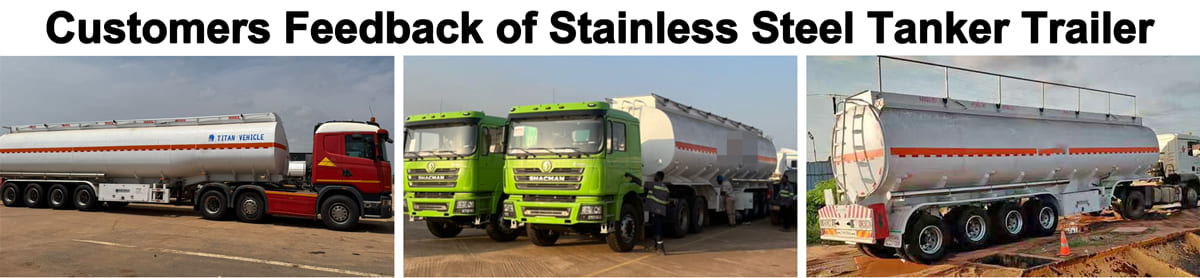 Get a Quote for a Stainless Steel Tanker Trailer from TITAN
Add: PLOT 3, OBA, AKRAN AVENUE, IKEJA, LAGOS