Nigeria Sinotruk Local Sales Center 2025 Howo New Model
Top One World Famous Brand - Sinotruk Nigeria
Nigeria Sinotruk Local Sales Center 2025 Howo New Model
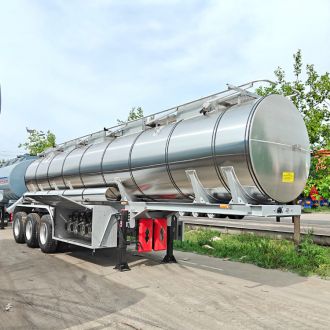
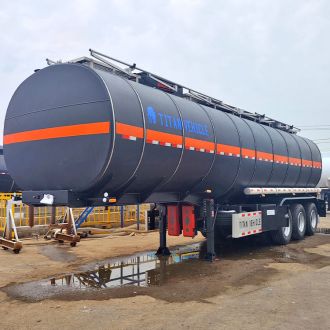
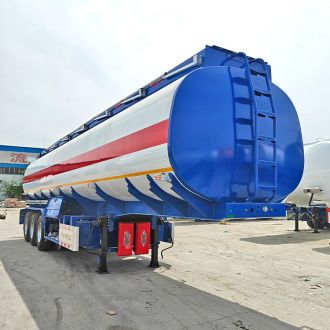
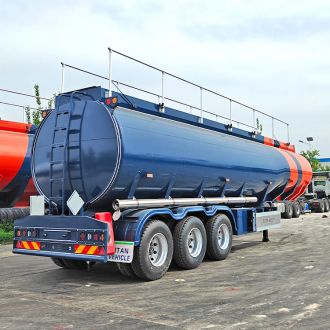
Choosing a fuel tanker trailer in Nigeria is primarily a matter of matching the tanker configuration to the cargo, operating requirement, and purchasing objective. Capacity alone does not determine whether a tanker is suitable. For buyers comparing an oil tanker trailer, the most important decision is usually between different configurations rather than between tanker and non-tanker equipment.
1.1 Match the Tanker to the Liquid Being Transported
The first decision when buying a fuel tanker trailer should be the liquid that the trailer will carry. Capacity is important, but the cargo determines which tank construction and unloading configuration should be considered.
A crude oil tanker trailer, for example, is not selected simply because it has a large tank. The buyer also needs to consider whether the stated carbon steel construction, single-compartment layout, and specified outlet arrangement match the intended crude oil transportation requirement. The supplied 40 m³ and 45 m³ carbon steel configurations provide two capacity options with a defined tank structure and complete trailer equipment.
A palm oil tanker creates a different selection question because the buyer may require a different tank material and product-handling arrangement. The supplied 40 m³ stainless steel 304 tanker provides an alternative to the carbon steel versions. It has a 4 mm shell, 5 mm head, and 4 mm baffle, together with stainless steel manholes and outlet components.
Asphalt is another distinct application. The supplied asphalt tanker is not simply a standard fuel tanker with a different label. It has a 5 cm carbon steel insulation layer, stainless steel bands, and a 6-inch rear discharge opening. These features make its configuration specifically different from the standard carbon steel oil tankers.
The practical lesson is simple: identify the cargo first, then choose the tanker. A request such as “I need an oil tanker” is not detailed enough for an accurate B2B quotation. The supplier should know what liquid will be transported, the required capacity, the desired tank material, and the unloading arrangement.
This approach is particularly useful in Nigeria because a buyer may be sourcing a tanker for direct operation, for a commercial fleet, or for resale to other customers. Each use case can require a different configuration.
1.2 Choose Capacity Based on Actual Transport Requirements
The best tanker capacity is the one that fits the transport requirement, not necessarily the one with the largest number. The supplied carbon steel models are 40 m³and 45 m³, providing a straightforward capacity comparison.
The 40 m³ model measures 10,800 x 2,500 x 3,750 mm. The 45 m³ model measures 11,700 x 2,500 x 3,800 mm. The additional 5 m³ therefore comes together with a longer overall trailer and a slightly greater overall height.
That makes capacity a practical fleet decision. A buyer who does not require the additional 5 m³ may prefer the 40 m³ version because of its shorter listed overall length. A buyer whose operation is built around the larger nominal capacity may consider the 45 m³ version instead.
The decision should therefore be based on how the tanker will actually be used. If the transport requirement is consistently closer to 40 m³, selecting a 45 m³ tanker simply because it is larger may not provide a meaningful advantage. Conversely, if the additional nominal volume is central to the operation, a 40 m³ configuration may not be the most suitable choice.
For a fuel tanker trailer in Nigeria, capacity should also be considered together with the physical dimensions stated in the supplier quotation. The tanker is not only a storage container; it is a complete semi-trailer that must fit the buyer's overall operating arrangement.
1.3 When a Single-Compartment Tank Makes Sense
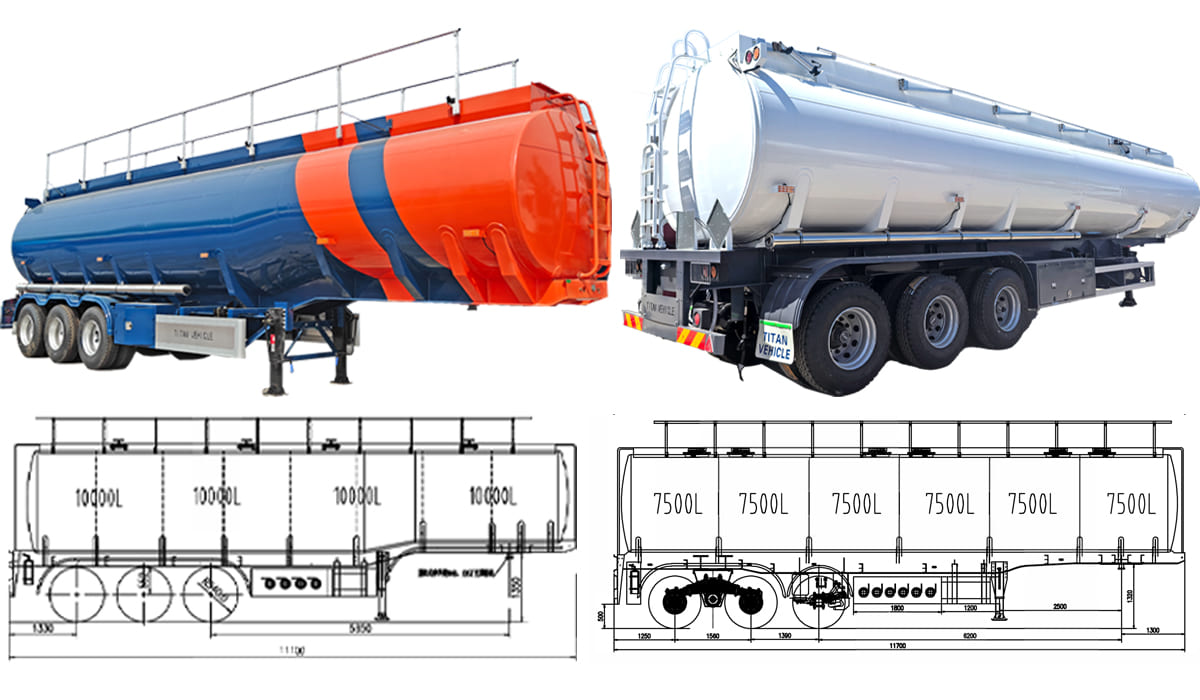
All four supplied configurations are described as single-compartment tankers. This means the listed models are designed around one main cargo compartment rather than several separately divided compartments.
A single-compartment tanker is appropriate to consider when the operating requirement is centered on carrying one type of liquid in each transport operation. It also simplifies the specification because the tank does not need to be divided into multiple separately managed sections.
However, a buyer who needs to transport different liquids separately should not assume that a single-compartment tanker can automatically provide that function. Such a requirement would need to be discussed with the supplier before the design is finalized.
This is an important distinction in B2B purchasing. A buyer might search for a fuel tanker trailer for sale and compare only capacities, while the actual difference needed for the operation is the compartment arrangement. The final inquiry should therefore state not only the desired volume but also whether one compartment is sufficient.
The single-compartment configuration also makes comparison easier among the supplied models. The 40 m³ carbon steel, 45 m³ carbon steel, 40 m³ stainless steel 304, and asphalt tanker can all be discussed within the same broad framework, while their material, dimensions, and discharge systems provide the major differences.
 Fuel Tanker Trailer in Nigeria: Crude Oil & Palm Oil Tanker Guide
2.1 40m³ Carbon Steel Tanker: When Is It the Better Choice?
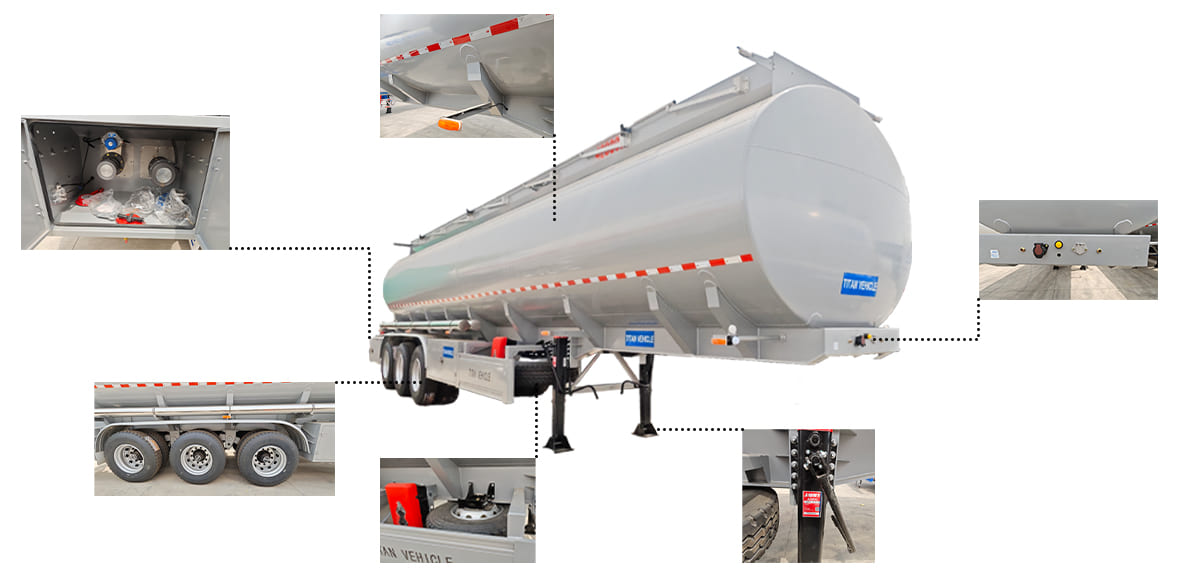
The 40 m³ carbon steel tanker is the most compact standard carbon steel configuration in the supplied range. Its stated overall dimensions are 10,800 x 2,500 x 3,750 mm, and the tank is a single-compartment construction.
Its tank specification includes a 5.75 mm head thickness, 4.75 mm shell thickness, and 3.75 mm baffle thickness. The running gear includes three TITAN 13-ton axles, 16T brake plates, 12 12R22.5 tires, and 12 9.0-22.5 steel rims.
The trailer also includes 28-ton external landing gear with gearbox, six pairs of air chambers, WABCO relay valves, a parking brake valve, 10 leaf springs, and 70# reinforced wear-resistant mechanical suspension.
For a buyer, the value of this configuration is not simply that it carries 40 m³. Its complete specification is already defined, allowing the buyer to evaluate the tanker as a whole.
The equipment package also includes one toolbox, one 50 or 90 assembled kingpin, two spare-tire brackets, two 8 kg fire extinguishers, tanker-specific LED lights and wiring, a standard lock box, folding guardrails, an anti-slip walkway, powder coating and baked paint, and full-trailer wax spraying.
This makes the model worth considering where 40 m³ is sufficient and the buyer wants a defined carbon steel tanker package rather than an unspecified tank body.
2.2 45m³ Carbon Steel Tanker: When Does the Extra Capacity Matter?
The 45 m³ carbon steel tanker is the natural choice to compare against the 40 m³ carbon steel version when the buyer wants greater nominal capacity without changing the basic tank material.
Its overall dimensions are 11,700 x 2,500 x 3,800 mm, so it is 900 mm longer and 50 mm higher than the 40 m³ carbon steel model. The tank remains a single-compartment design with the same stated 5.75 mm head, 4.75 mm shell, and 3.75 mm baffle thicknesses.
The major chassis specification is also similar. It uses three TITAN (Zhengyang) 13-ton axles with 16T brake plates, 12 12R22.5 tires, 12 9.0-22.5 steel rims, 28-ton external landing gear with gearbox, six pairs of air chambers, WABCO relay valves, a parking brake valve, and 10-leaf 70# reinforced wear-resistant mechanical suspension.
The key reason to choose the 45 m³ version is therefore the additional stated capacity. The buyer should consider whether that additional capacity fits the intended transport requirement well enough to justify the larger overall dimension.
This is a more useful way to understand the two models than simply saying that one is “small” and one is “large.” The practical difference is a trade-off between nominal capacity and overall physical size, while many of the major tanker components remain similar.
2.3 40m³ Stainless Steel 304 Tanker: When Should You Choose It?
The 40 m³ stainless steel 304 tanker should be considered when the buyer specifically needs the stainless steel configuration rather than simply looking for a different capacity.
The stated dimensions are 11,500 x 2,500 x 3,950 mm, with a 4 mm shell, 5 mm head, and 4 mm baffle. Like the carbon steel models, it is a single-compartment tanker.
The discharge configuration is also different. It includes two stainless steel manhole covers, two 3-inch stainless steel outlets, and one 4-inch stainless steel bottom valve, together with two 3-inch x 6 m discharge hoses.
Its running components include three TITAN (Zhengyang) 13-ton/16-ton brake axles, 12 12R22.5 tires, 10 leaf springs, a relay valve, four single and two double air chambers, two 8 kg fire extinguishers with iron barrels, an iron curved mudguard, a 2-inch assembled kingpin, and 28T single-acting external gearbox landing gear.
This configuration demonstrates why capacity alone is not enough. A 40 m³ stainless tanker and a 40 m³ carbon steel tanker have the same nominal capacity, but they are different products in terms of material, dimensions, and discharge components.
The correct choice therefore depends on the actual cargo and technical specification required by the buyer.
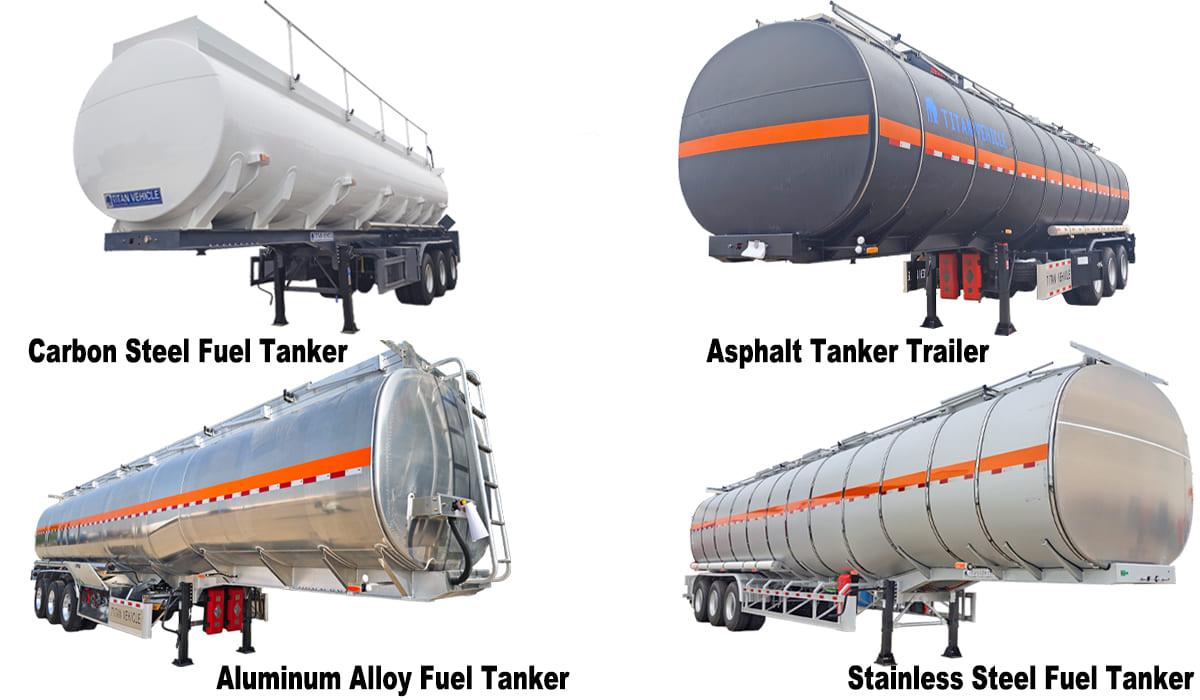
2.4 Configuration Comparison: Capacity, Material and Dimensions
| Configuration | Capacity | Overall Dimensions(mm) | Tank Material | Tank Thickness | Discharge Arrangement |
|---|---|---|---|---|---|
| 40 m³ Carbon Steel | 40 m³ | 10,800 × 2,500 × 3,750 | Carbon steel | 5.75 / 4.75 / 3.75 mm | 4-inch bottom valve + 4-inch API aluminum alloy discharge valves |
| 45 m³ Carbon Steel | 45 m³ | 11,700 × 2,500 × 3,800 | Carbon steel | 5.75 / 4.75 / 3.75 mm | 4-inch bottom valve + 4-inch API aluminum alloy discharge valves |
| 40 m³ Stainless Steel | 40 m³ | 11,500 × 2,500 × 3,950 | Stainless steel 304 | 5 / 4 / 4 mm | Stainless steel outlets + 4-inch bottom valve + hoses |
| Asphalt Tanker | 38 m³ | 11,500 × 2,500 × 3,700 | Carbon steel | 5.75 / 4.75 / 3.75 mm | 6-inch rear discharge opening |
The comparison makes one point particularly clear: the same tanker category can contain very different purchasing priorities. The 40 m³ carbon steel and 45 m³ carbon steel models are primarily a capacity choice. The 40 m³ stainless steel 304 model is primarily a material and discharge-system choice. The asphalt tanker is a specialized application choice.
For buyers comparing an oil tanker trailer for sale, these distinctions are more useful than a generic ranking of models.
 Fuel Tanker Trailer in Nigeria: Crude Oil & Palm Oil Tanker Guide
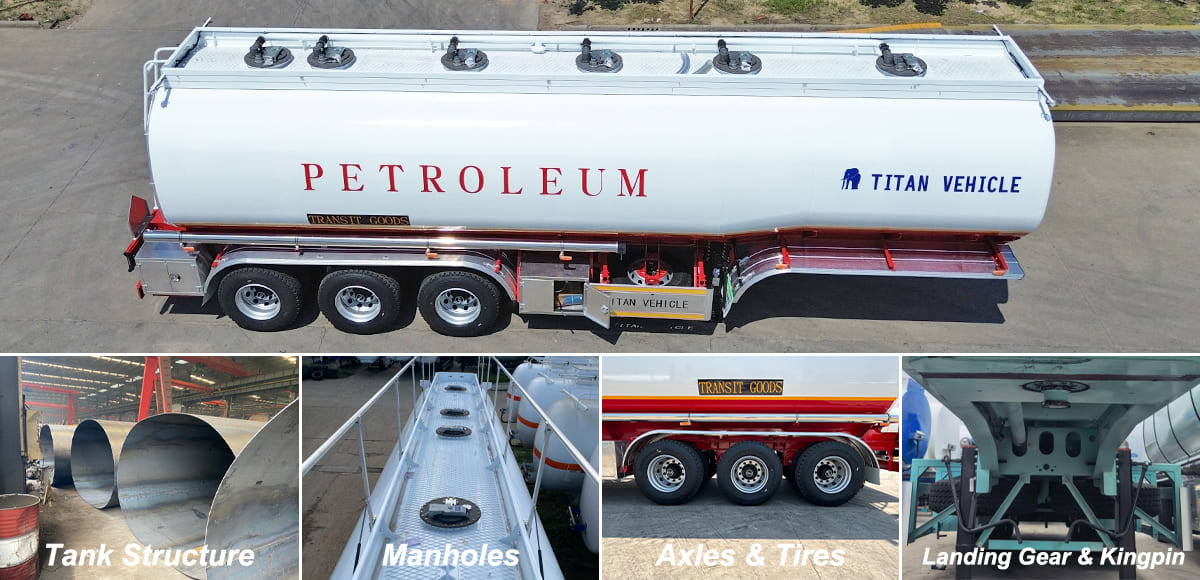
3.1 Tank Thickness and Internal Structure
The tank structure deserves careful attention because it is the part of the trailer that directly contains the cargo.
The standard 40 m³ and 45 m³ carbon steel configurations use a 5.75 mm head thickness, 4.75 mm shell thickness, and 3.75 mm baffle thickness. The stainless steel 304 configuration uses 5 mm heads, 4 mm shell thickness, and 4 mm baffles.
These are useful specifications during supplier comparison because they make the quoted construction more precise. Instead of comparing two tankers based only on a statement such as “40 m³ carbon steel,” the buyer can compare the actual head, shell, and baffle specifications.
The baffle specification is part of the internal tank construction. The supplied information identifies the thickness but does not provide additional engineering data about baffle arrangement or performance, so those details should not be inferred beyond the stated specification.
For B2B purchasing, the important point is that the tank construction should be written clearly into the order specification. A capacity figure without construction details does not fully describe the product.
3.2 Manholes, Bottom Valves and Oil Outlets
The unloading system is one of the most important differences between the supplied configurations.
The 40 m³ and 45 m³ carbon steel models include two European-standard aluminum manhole covers with breathing valves, one 4-inch bottom valve, and two 4-inch API aluminum alloy oil discharge valves with matching reducer fittings. The stainless steel 304 model uses two stainless steel manhole covers, two 3-inch stainless steel outlets, one 4-inch stainless steel bottom valve, and two 3-inch x 6 m discharge hoses.
These configurations should not be treated as interchangeable. A buyer's unloading process determines which arrangement is practical. The outlet size and connection type should therefore be included in the initial specification request. This is particularly important when comparing prices. A quotation that appears less expensive may simply contain a different outlet package. The buyer should compare the actual components, not the product name alone.
3.3 Axles, Tires and Mechanical Suspension
The running gear is another major part of the tanker purchase.
The carbon steel tankers use three TITAN 13-ton axles, 16T brake plates, 12 12R22.5 tires, and 12 9.0-22.5 steel rims. They are also equipped with 10 leaf springs and 70# reinforced wear-resistant mechanical suspension. The stainless steel 304 model also has three TITAN axles and 12 12R22.5 tires, but its specification should be checked as its component arrangement is not identical in every detail.
When buying an oil tanker trailer, the axle and suspension information should be stated explicitly in the quotation. “Three-axle tanker” describes only a basic configuration; it does not tell the buyer the exact axle specification, tire size, rim configuration, brake arrangement, or suspension construction. This information becomes especially important when comparing different suppliers because a similar tank volume can be paired with different chassis specifications.
3.4 Braking, Landing Gear and Kingpin
The carbon steel configurations include six pairs of air chambers, WABCO relay valves, and a parking brake valve. They also specify 28-ton external landing gear with gearbox and one 50 or 90 assembled kingpin.
The stainless steel 304 model uses four single and two double air chambers, a standard relay valve, 28T single-acting external gearbox landing gear, and a 2-inch assembled kingpin.
These differences demonstrate why the chassis should be evaluated as a complete system. A buyer should not assume that every three-axle tanker has the same air chamber arrangement, landing gear, or kingpin. A complete quotation gives the buyer something concrete to compare. It also makes it easier to confirm what the supplier will actually manufacture.
 Fuel Tanker Trailer in Nigeria: Crude Oil & Palm Oil Tanker Guide
4.1 Crude Oil Transport: What Should Buyers Specify?
A crude oil tanker trailer should be specified around the actual crude oil transportation requirement. The most relevant choices within the supplied range are the 40 m³ and 45 m³ carbon steel configurations, both using single-compartment tanks.
The 40 m³ tanker measures 10,800 x 2,500 x 3,750 mm, while the 45 m³ tanker measures 11,700 x 2,500 x 3,800 mm. Both use the same stated tank thicknesses and similar major chassis equipment.
The choice between them therefore begins with capacity. If 40 m³ fits the planned transport operation, the smaller configuration may be the more appropriate starting point. If the additional 5 m³ is a meaningful part of the operating requirement, the 45 m³ model can be considered.
The buyer should also confirm the unloading arrangement before finalizing the purchase. Both carbon steel models include the specified 4-inch bottom valve and two 4-inch API aluminum alloy oil discharge valves with reducer fittings.
The supplied information does not establish that every crude oil application requires one universal tanker configuration. Cargo-specific technical requirements must therefore be confirmed before the final order.
4.2 Palm Oil Transport: When Does Tank Material Matter?
A palm oil tanker should be selected according to the cargo-handling requirement, including the specified tank material and discharge arrangement.
The supplied 40 m³ stainless steel 304 tanker is the clearest alternative to the carbon steel configurations. It uses stainless steel 304 construction, with a 4 mm shell, 5 mm head, and 4 mm baffle, plus stainless steel manholes and outlet components.
This can be relevant when stainless steel construction is part of the buyer's required specification. However, the product information alone does not establish that stainless steel is mandatory for every palm oil application.
The purchasing decision should therefore start with the actual cargo requirement and then determine whether the stainless steel configuration is appropriate. The buyer should also confirm the required outlet size, hose arrangement, and valve construction.
For a Nigerian buyer searching for a palm oil tanker, this is more useful than simply selecting the tanker with the largest volume. A 40 m³ tanker can be technically different depending on how its tank and discharge system are constructed.
4.3 Asphalt Transport: Why Is an Insulated Tank Different?
The asphalt tanker requires a separate approach because its supplied specification contains dedicated insulation and discharge features.
Its overall dimensions are 11,500 x 2,500 x 3,700 mm. The tank is a single-compartment construction with a 5.75 mm head, 4.75 mm shell, and 3.75 mm baffle.
Its most distinctive specification is the 5 cm carbon steel insulation layer, combined with stainless steel bands. The trailer also has a 6-inch rear discharge opening.
The chassis specification includes three TITAN (Zhengyang) 13-ton axles with 16T brake plates, 12 12R22.5 tires, 9.0-22.5 rims, six pairs of air chambers, a WABCO relay valve, a parking brake valve, 10 leaf springs, 70# reinforced wear-resistant mechanical suspension, one toolbox, two spare-tire brackets, 28-ton external landing gear with gearbox, tanker-specific LED lights and wiring, folding guardrails, an anti-slip walkway, powder coating, baked paint, and full-trailer wax spraying.
These details show that an asphalt tanker is not simply a standard fuel tanker trailer with a different cargo label. Its insulation and rear discharge arrangement make the configuration application-specific.
4.4 Match the Discharge System to the Actual Unloading Process
The discharge system should be defined before purchase because it connects the tank to the actual cargo-handling process.
The carbon steel configurations use 4-inch bottom and API discharge equipment, while the stainless steel configuration uses 3-inch stainless steel outlets, a 4-inch stainless steel bottom valve, and 6-meter discharge hoses. The asphalt tanker uses a 6-inch rear discharge opening.
A buyer should therefore ask the supplier to confirm the outlet sizes, valve materials, connection types, and included hoses or reducer fittings.
This is particularly important when purchasing an oil tanker trailer in Nigeria for an existing operation. The tanker needs to fit the buyer's unloading equipment and process. A tank capacity can be correct while the outlet configuration is wrong for the intended application.
For the same reason, a supplier should not quote an unspecified “standard discharge system” when the buyer is comparing different tanker models. The exact components are more useful for making a purchasing decision.
 Fuel Tanker Trailer in Nigeria: Crude Oil & Palm Oil Tanker Guide
5.1 What to Put in a Tanker Trailer Quotation
A useful quotation for a fuel tanker trailer in Nigeria should begin with a clear technical specification. The buyer should identify the cargo, required capacity, tank material, compartment arrangement, dimensions, and unloading arrangement before comparing supplier prices.
The 40 m³ carbon steel model, for example, should be quoted as a specific configuration with 40 m³ capacity, 10,800 x 2,500 x 3,750 mm dimensions, the stated tank thicknesses, three 13-ton TITAN (Zhengyang) axles, 12 12R22.5 tires, 28-ton landing gear, mechanical suspension, braking components, and the listed tanker accessories.
A similar level of detail should be used for the 45 m³ and stainless steel configurations.
The more specific the request, the easier it becomes to compare different suppliers. A buyer can then determine whether each quotation is describing an equivalent tanker or a different configuration.
5.2 How to Compare Different Supplier Quotes
The correct way to compare an oil tanker trailer for sale is to compare equivalent specifications line by line.
Start with capacity and dimensions, then compare tank material and thickness, compartment arrangement, axles, tires, rims, brakes, suspension, landing gear, kingpin, manholes, valves, outlets, hoses, fire extinguishers, lighting, guardrails, and surface treatment.
The carbon steel models provide a useful example of why this matters. Both include two spare-tire brackets, a toolbox, two 8 kg fire extinguishers, tanker-specific LED lights and wiring, a standard lock box, folding guardrails, an anti-slip walkway, powder coating and baked paint, and full-trailer wax spraying.
The stainless steel configuration has a somewhat different accessory arrangement, including one spare-tire bracket, stainless steel discharge components, discharge hoses, an iron curved mudguard, and a different kingpin and air-chamber specification.
These differences should be reflected in the quotation. A cheaper price is not necessarily a better quotation if important equipment has been excluded.
5.3 How Capacity and Configuration Affect Price
When buyers search for fuel tanker trailer price, the actual selling price cannot be determined from capacity alone. The supplied product information does not provide a fixed selling price, so no unsupported price should be attached to these models. Instead, the quotation should be linked to the exact configuration.
A 40 m³ carbon steel tanker and a 40 m³ stainless steel 304 tanker both have a stated capacity of 40 m³, but their tank materials, dimensions, thicknesses, outlet systems, and some chassis components differ. They therefore represent different purchasing specifications.
The same applies to the 40 m³ and 45 m³ carbon steel models. The 45 m³ version provides an additional 5 m³ of stated capacity and has a longer overall body.
Price comparison is meaningful only after these differences have been made clear. A Nigerian buyer should therefore ask suppliers to quote against the same technical specification whenever possible.
This is also useful for distributors. A distributor purchasing several fuel tanker trailers in Nigeria may want a consistent specification across the batch. In that case, the complete build specification becomes the basis for supplier comparison rather than the basic product name.
5.4 What to Confirm Before Production
Before production starts, the buyer should have one confirmed specification covering the entire tanker.
For the 40 m³ carbon steel model, the confirmed document should state 40 m³, 10,800 x 2,500 x 3,750 mm, carbon steel construction, 5.75 mm head, 4.75 mm shell, 3.75 mm baffle, three TITAN (Zhengyang) axles, 12 12R22.5 tires, the specified brake arrangement, suspension, landing gear, kingpin, discharge system, and accessory package.
For the 45 m³ model, the document should state 45 m³ and 11,700 x 2,500 x 3,800 mm, together with its corresponding equipment.
For the stainless steel model, the final specification should confirm 40 m³ stainless steel 304, 11,500 x 2,500 x 3,950 mm, 4 mm shell, 5 mm head, 4 mm baffle, and the stainless steel outlet and hose arrangement.
For the asphalt tanker, the order should confirm the 5 cm insulation layer, stainless steel bands, 6-inch rear discharge opening, and the remaining listed equipment.
This final confirmation protects both sides from specification misunderstandings. The buyer knows what is being ordered, and the supplier has one clear manufacturing reference.
5.5 Nigeria Is a Purchasing Market, Not Just a Keyword
For a B2B buyer in Nigeria, the target country becomes important when it is connected to the actual procurement situation.
A fleet operator may need one standard tanker configuration for repeated operations. A distributor may need to decide which capacity and material combination is most suitable for its customers. An importer may be comparing manufacturers on both technical content and price.
In all of these cases, the strongest purchasing inquiry is specific. Instead of sending a generic request for an oil tanker trailer, the buyer can state the intended cargo, required capacity, tank material, single-compartment arrangement, dimensions, axle configuration, tire size, discharge system, and accessory requirements. That makes the supplier's response more useful because the quotation is based on a defined specification rather than a general category.
For a Nigerian buyer, it is also sensible to verify any external technical, inspection, road-use, or cargo-specific requirements that apply to the intended operation before finalizing the order. Such requirements are not provided in the product specifications above and should therefore not be assumed.
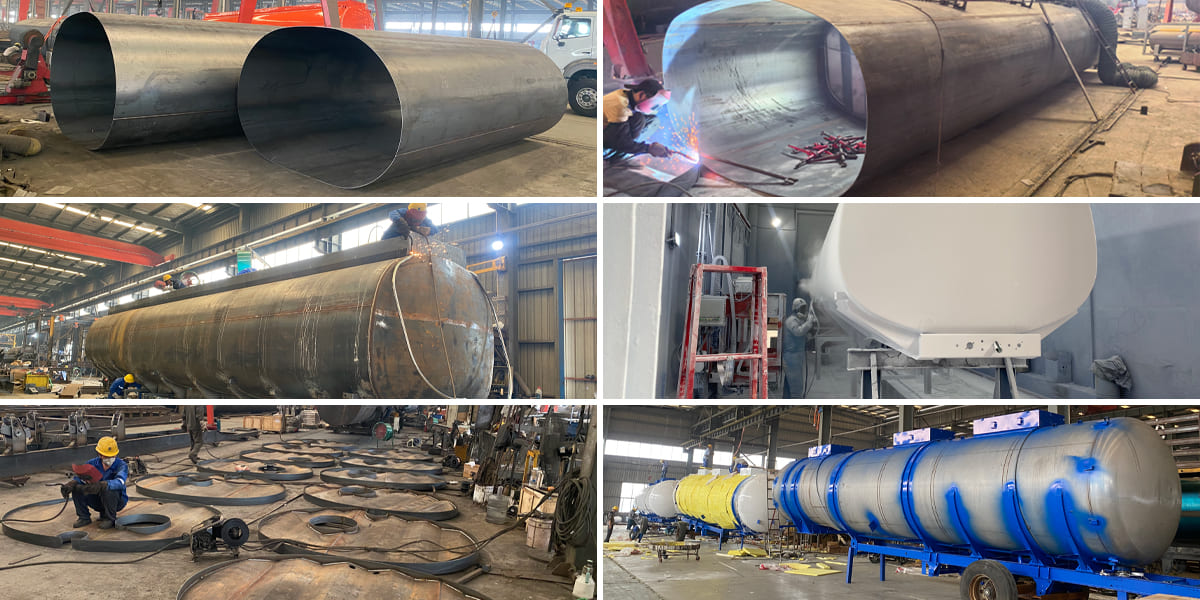 Fuel Tanker Trailer in Nigeria: Crude Oil & Palm Oil Tanker Guide
5.6 Direct Factory Communication Works Best With a Defined Requirement
A factory quotation becomes more useful when the customer knows what needs to be quoted. A message such as “Send me your best price for a crude oil tanker trailer” leaves many questions unanswered. A more useful request identifies the desired capacity, tank material, compartment arrangement, dimensions, axle setup, tires, braking configuration, discharge components, and accessories.
For example, a customer may ask for a 40 m³ carbon steel single-compartment tanker and specify the stated tank thicknesses and discharge equipment. Another customer may request a 40 m³ stainless steel 304 configuration with its stainless steel outlet arrangement. This approach reduces unnecessary back-and-forth and allows the buyer to compare the resulting quotation with other manufacturers more accurately.
5.7 The Best Purchase Is the Best-Matched Configuration
There is no universal tanker model that is automatically right for every buyer. The correct decision depends on the cargo, capacity, material, dimensions, discharge system, and complete chassis specification.
For the standard carbon steel range, the central decision is whether 40 m³ or 45 m³ better fits the operation. For a material-specific requirement, the 40 m³ stainless steel 304 tanker provides a different configuration. For asphalt transportation, the insulated asphalt tanker is the relevant option. The value of a B2B buying guide is therefore not to tell every purchaser to choose the same tanker. It is to show how the specification changes the decision.
A buyer in Nigeria who defines the application first can then compare the available models with much greater confidence. Instead of asking which tanker is “best,” the more useful question becomes: which tanker specification best matches this particular cargo and operating requirement?
6.1 What size fuel tanker trailer is best for Nigeria?
The best capacity depends on the actual transport requirement. The supplied standard carbon steel options are 40 m³ and 45 m³, so the buyer should compare the required capacity with the different overall dimensions.
6.2 What is the difference between the 40 m³ and 45 m³ carbon steel tankers?
Both are single-compartment carbon steel tankers with the same stated head, shell, and baffle thicknesses. The 45 m³ version increases the stated capacity to 45 m³ and has a longer and slightly higher overall dimension.
6.3 Is stainless steel better for a palm oil tanker?
Stainless steel 304 is a different tank-material option, not automatically a better choice for every application. The correct selection depends on the actual cargo-handling requirement and the buyer's specified material and discharge system.
6.4 What is the difference between a fuel tanker trailer and a crude oil tanker trailer?
Both are tank semi-trailers used for liquid transport, but the required configuration depends on the cargo and handling process. Capacity, tank material, compartment arrangement, and discharge equipment should be confirmed for the specific crude oil application.
6.5 What should I check before buying an oil tanker trailer?
Check the complete specification, including capacity, dimensions, tank material, tank thicknesses, axles, tires, brakes, suspension, landing gear, kingpin, manholes, valves, discharge equipment, and included accessories. Comparing the complete specification is more useful than comparing the product name or headline price.
6.6 What affects fuel tanker trailer price?
The quotation can change according to capacity, tank material, dimensions, axle and braking configuration, suspension, discharge equipment, accessories, and customization requirements. A fixed price cannot be determined without a defined specification.
Add: PLOT 3, OBA, AKRAN AVENUE, IKEJA, LAGOS