Nigeria Sinotruk Local Sales Center 2025 Howo New Model
Top One World Famous Brand - Sinotruk Nigeria
Nigeria Sinotruk Local Sales Center 2025 Howo New Model
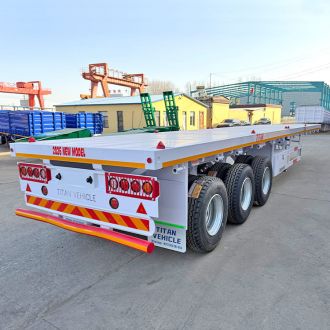
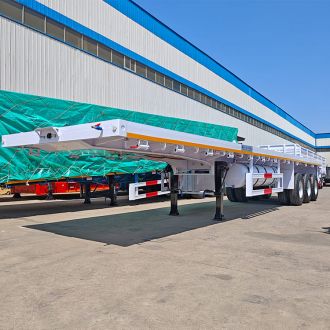
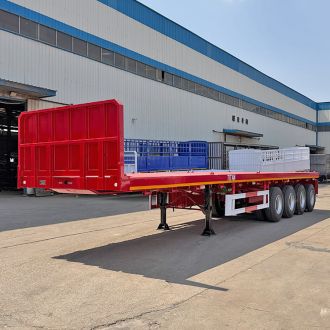
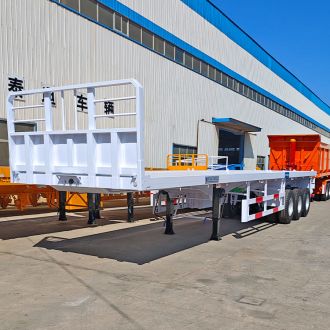
For buyers in Nigeria, choosing a flatbed trailer is less about finding the lowest advertised price and more about matching the trailer structure to the cargo, loading method, and expected working load. A trailer used mainly for containers may have different requirements from one used to move machinery, steel products, industrial components, or construction materials.
When comparing a flatbed trailer price, buyers therefore need to look beyond the number shown in an online listing. The overall dimensions, axle arrangement, main beam construction, suspension, tires, braking system, container locks, and rated load requirement can all change the actual value of a trailer. The same principle applies when comparing a flatbed trailer for sale in Nigeria. For Nigerian buyers searching for a flatbed trailer for sale in Nigeria, the more useful question is which configuration corresponds to the cargo weight, cargo dimensions, loading method, and operating requirements of the fleet.
|
4. Which Flatbed Trailer Should You Choose? |
A flatbed trailer is a semi-trailer with an open, level cargo deck rather than an enclosed cargo body. Because there are no permanent tall side walls around the main deck, cargo can be loaded from the rear, from the side, or from above when the working environment allows it.
This open structure is one of the main reasons a flatbed trailer for sale can serve several types of transport work. Containers, steel products, machinery, construction materials, palletized goods, structural components, and other large or awkward cargo can be placed directly onto the deck without passing through an enclosed cargo door.
For Nigerian fleets, the same design can be useful when one trailer needs to handle more than one category of cargo. However, the flexibility of an open deck does not mean that every cargo can be transported with every flatbed configuration. Weight, dimensions, center of gravity, support points, and securing requirements still have to match the trailer.
1.1 Why Is It Called a Flatbed Trailer For Sale?
The term flatbed comes from the basic construction of the trailer: the cargo platform is essentially a flat structural deck without a fixed enclosed body. That structure leaves more of the deck accessible for loading and unloading.
For a buyer comparing a flatbed trailer for sale in Nigeria, this open layout can be important when loading equipment with a crane or handling cargo with a forklift. When site conditions allow, the loading equipment does not have to work through a narrow enclosed opening.
The flat structure can also make one trailer useful for different cargo types. A trailer may be used for container transport during one trip and for general cargo during another, provided the cargo dimensions, total weight, distribution, and securing method remain within the intended operating configuration.
This is also why the flatbed trailer price should be evaluated together with the intended application. A simple deck does not necessarily mean a simple or lightly built trailer. A heavy-duty flatbed may contain substantial structural steel in the main beams, cross members, side members, reinforcement, and suspension system.
1.2 What Can You Use a Flatbed Trailer For?
A flatbed can be used for container transport and many forms of general cargo that can be safely carried on an open platform.
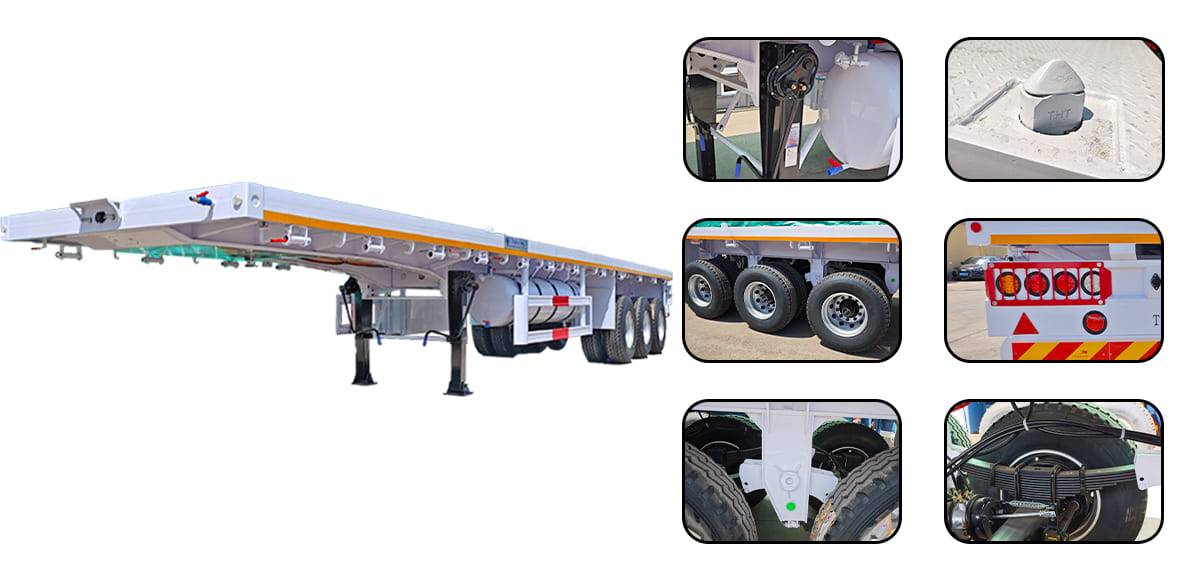
The supplied configurations are particularly suited to container applications because they use 12 container locks and an overall platform dimension of 12,500 × 2,500 × 1,530 mm. This is a 40-foot-class trailer configuration commonly associated with container transportation.
A flatbed trailer for sale can also be used for industrial equipment, structural materials, machinery, steel products, construction-related cargo, and other loads that do not need an enclosed body. Whether a particular cargo is suitable depends on its weight, dimensions, center of gravity, support points, and securing requirements.
For Nigerian transport companies operating mixed fleets, that flexibility can be useful. Instead of limiting the trailer to one specialized type of cargo, an open deck can support different transport tasks. At the same time, the buyer should not assume that a general-purpose deck automatically has sufficient structural capacity for every heavy load.
When selecting a flatbed trailer for sale in Nigeria, it is therefore better to start with the work the trailer will actually perform. The cargo determines the required structural configuration, while the trailer configuration determines which cargo loads can be handled appropriately.
1.3 Flatbed vs. Lowbed: Which One Fits?
The difference between a flatbed and a lowbed is primarily functional.
A flatbed uses a relatively level open deck and is generally intended for cargo such as containers and general loads that can be transported without a specially lowered platform. A lowbed, by contrast, is designed around a lower deck arrangement and is more appropriate for certain oversized or high-profile machinery where overall transport height is an important consideration.
For a fleet mainly handling containers, steel products, industrial components, and other general cargo, a flatbed configuration may directly correspond to the required loading pattern. For transportation centered on excavators or other high-profile construction machinery, the deck height of a lowbed may become more important. A buyer comparing flatbed trailer prices with lowbed prices should therefore avoid comparing the two only by purchase cost. They solve different transport problems.
 Flatbed Trailer for Sale in Nigeria | Flatbed Trailer Price, Specifications
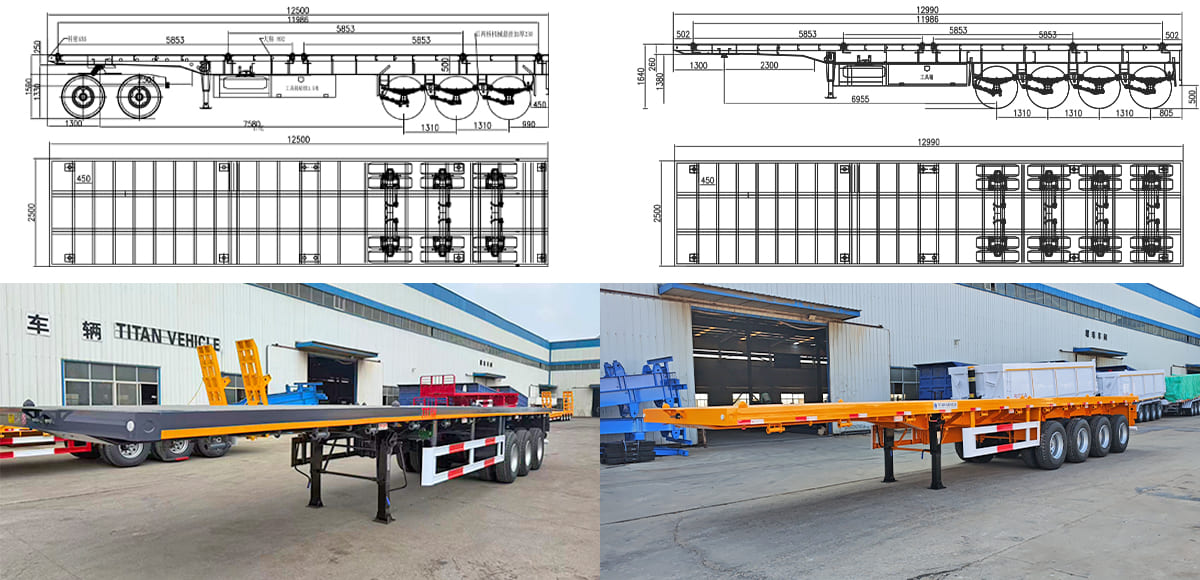
The supplied flatbed configurations use an overall dimension of 12,500 × 2,500 × 1,530 mm.
When evaluating a flatbed trailer for sale, buyers should also consider deck width, deck height, axle arrangement, container locking points, structural dimensions, and the relationship between the cargo dimensions and the available support area.
The two configurations supplied for this article have the same overall external dimensions but are intended for different load requirements. The 3-axle version is specified around a 60-ton load requirement, while the 4-axle version is specified around an 80-ton load requirement.
This difference is important when comparing flatbed trailer price quotations because higher capacity is not created simply by increasing the nominal number printed in a product title. Structural members and load-bearing components also change.
For buyers searching for a flatbed trailer for sale in Nigeria, the technical drawing and complete specification are therefore more useful than a rounded product description alone.
2.1 How Big Is a Semi-Trailer in Feet?
A trailer used for container transportation is often described using feet because containers themselves are commonly identified using measurements such as 20 feet and 40 feet.
The configurations discussed here have an overall length of 12,500 mm, which is approximately 41 feet from end to end. They are also described as 40-foot-class flatbed configurations for container applications.
This distinction matters when comparing listings online. A supplier may describe a product as a “40 ft flatbed” because of its intended container application, while the actual trailer length measured from end to end is slightly greater than 40 feet.
For a Nigerian procurement project, the exact millimeter dimensions should therefore be confirmed in the technical specification rather than relying only on a rounded term in a listing title.
The same approach is useful when comparing flatbed trailer prices from different suppliers. One quotation may describe a trailer according to the container it carries, while another may show the exact overall trailer dimensions. These descriptions may refer to similar applications but should still be checked against the actual drawings.
2.2 How Much Weight Can a Flatbed Carry?
The supplied 3-axle configuration is specified around a 60-ton load requirement, while the supplied 4-axle configuration is specified around an 80-ton load requirement.
These figures represent the intended load levels of the specific configurations provided. They should not be interpreted as a universal statement that every flatbed trailer can safely carry those weights. Actual operating capability depends on the complete vehicle system. The frame, axles, suspension, brakes, tires, kingpin, tractor combination, cargo distribution, and operating conditions all influence how the trailer performs under load.
This is why a buyer should not select a trailer simply because one listing shows a higher number. For a Nigerian fleet, the appropriate question is whether the stated capacity corresponds to the actual cargo requirement.
The flatbed trailer price should then be evaluated against that configuration. A heavier structural system can increase manufacturing cost, but choosing a configuration that is substantially heavier than the actual application can also mean paying for capacity that is rarely used.
2.3 What Determines Real Carrying Capacity?
Real carrying capacity is determined by the entire load-bearing system rather than one individual specification.
The main longitudinal beams carry major bending loads through the frame. Cross members distribute forces across the deck. The suspension transfers load toward the axles, while tires, wheels, brakes, and the tractor-trailer connection have to handle the forces generated during acceleration, braking, turning, and road movement.
A load placed evenly across the deck creates a different structural condition from a heavy piece of equipment concentrated in one small area. The cargo's center of gravity and support points can also affect the way forces are transferred into the trailer. For this reason, the 60-ton and 80-ton figures should be considered together with the complete engineering configuration. A Nigerian buyer comparing a flatbed trailer for sale should therefore request the actual structural specification rather than judging capacity based only on an online headline.
 Flatbed Trailer for Sale in Nigeria | Flatbed Trailer Price, Specifications
The important engineering question is not simply whether a flatbed trailer for sale has an open deck. The more important question is whether the frame and supporting components are designed around the expected cargo and repeated commercial operation.
The supplied configurations use Q345 steel for the main longitudinal beams and include reinforcement in structural areas of the frame. The deck is therefore part of a larger load-bearing system consisting of main beams, cross members, side members, suspension, axles, tires, and other supporting components. For buyers comparing flatbed trailer prices, these hidden structural differences can explain why two products with similar overall dimensions have different quotations.
3.1 Main Beam Design
Both configurations have a main beam height of 500 mm, but the material thickness of the major beam components differs.
The 3-axle model uses a 14 mm upper flange, 8 mm web, and 16 mm lower flange. The 4-axle model uses a heavier structure with a 20 mm upper flange, 10 mm web, and 20 mm lower flange.
These differences are significant because the longitudinal beam is one of the key structural elements of the trailer. It must resist bending and transfer cargo loads through the chassis toward the suspension and axles. The 4-axle configuration should therefore not be understood simply as a 3-axle trailer with an additional axle. Its main beam structure is also upgraded.
For a buyer checking flatbed trailer price differences, the thickness of these structural members can provide a more useful explanation than looking only at the product's exterior appearance. A supplier quotation that identifies the steel grade, beam height, flange thickness, and web thickness allows the buyer to compare the actual construction rather than comparing two generic descriptions of “heavy-duty flatbed.”
3.2 Cross Members and Side Structure
The supplied 3-axle configuration uses 16# channel steel for the side beams, while the 4-axle configuration uses 18# channel steel.
Both configurations use 10# channel steel cross members and a 3 mm checkered plate deck. The cross members connect the primary longitudinal structure and help distribute the forces generated by cargo across the trailer width. The deck plate then forms the working surface on top of that structural framework. The checkered surface is also practical for an open cargo platform because it provides a working deck rather than a simple smooth sheet.
However, the deck plate itself should not be treated as the main reason for a trailer's load capacity. The principal structural contribution comes from the complete frame, including the main beams, cross members, side members, reinforcements, suspension, and axle system. The stronger 18# channel steel side structure in the 4-axle configuration complements its heavier main beam specification. That is one reason the two products should be assessed as different load configurations when comparing a flatbed trailer for sale in Nigeria.
3.3 Reinforcement Where the Frame Needs It
The supplied design includes reinforcement around several structural transition areas, including the gooseneck upright plates and lower flange, together with diagonal supports.
These areas deserve attention because forces are not distributed evenly across the entire trailer frame. Connections, structural transitions, and areas around the gooseneck can experience concentrated loads when the trailer is loaded, unloaded, braked, or operated over uneven surfaces. Reinforcement helps maintain continuity between these components and supports the overall frame structure.
The supplied suspension specification is 8 mm thick, and the trailer uses a 70 mm center pin. These details may receive less attention than the overall length or stated capacity, but they form part of the complete engineering specification. For a buyer reviewing flatbed trailer prices, looking at these smaller structural details can help distinguish a complete technical specification from a simplified online product listing.
3.4 Axles, Brakes, Tires, and Suspension
The supplied 3-axle configuration uses TITAN 13-ton axles, 16-ton brake linings, 12 TITAN 12R22.5 tires, and 12 900 × 22.5 steel rims. It also uses 10 pieces of 13 mm thick leaf springs.
The supplied 4-axle configuration is identified as a 4-axle flatbed configuration, but the component description also references three TITAN 13-ton axles. Because this information is internally inconsistent, the final axle quantity should be confirmed in the production drawing and final order specification before manufacturing. For B2B procurement, this type of specification confirmation is important. Axle quantity and axle rating affect load distribution, suspension requirements, and the configuration of the complete trailer.
The braking system also forms part of the overall specification. The supplied design uses a WABCO brake valve, while the lighting system uses LED lights and waterproof electrical cables. For a flatbed trailer for sale in Nigeria, the trailer should be checked as a complete tractor-trailer system. The kingpin, braking arrangement, electrical connections, axle configuration, and tire specification should all be compatible with the tractor that will operate the trailer.
3.5 Container Locks and Practical Loading
Both supplied configurations include 12 container locks.
These locks are particularly relevant for container transportation because they create designated securing points for compatible containers rather than requiring the buyer to develop a securing solution on a completely general cargo deck.
These are not headline capacity specifications, but they are practical fleet-use features. When comparing a flatbed trailer for sale, buyers should consider the complete equipment configuration rather than looking only at the number displayed next to the product name.
The kingpin is specified as a 2-inch (50 mm) assembled kingpin. Because the kingpin provides the mechanical connection between the semi-trailer and the tractor's fifth wheel, tractor compatibility should be confirmed during procurement.
 Flatbed Trailer for Sale in Nigeria | Flatbed Trailer Price, Specifications
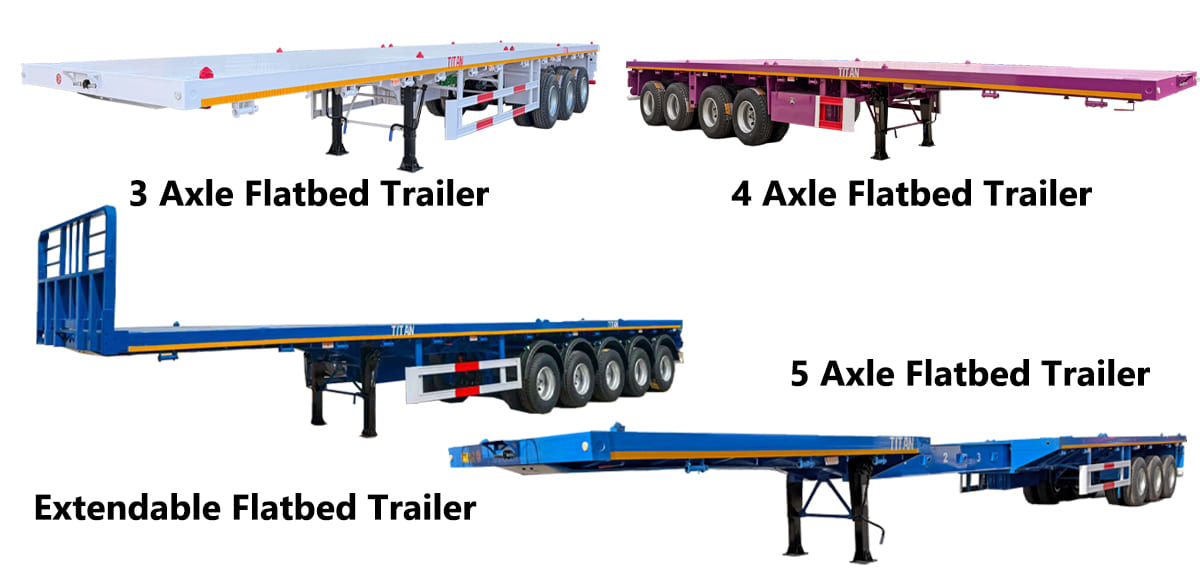
The appropriate flatbed configuration depends on the actual work the trailer needs to perform.
For applications centered around the supplied 60-ton configuration, the 3-axle model provides one structural and load-handling option. For applications corresponding to the supplied 80-ton configuration, the 4-axle model uses heavier structural members and provides another. Therefore, when comparing a flatbed trailer for sale, the starting point should be the cargo requirement rather than the advertised price.
4.1 3-Axle vs. 4-Axle
The most useful comparison is not simply axle count. The structural specifications also change between the two configurations.
| Feature | 3-Axle Flatbed Trailer | 4-Axle Flatbed Trailer |
|---|---|---|
| Overall dimension | 12,500 × 2,500 × 1,530 mm | |
| Stated load requirement | 60 tons | 80 tons |
| Main beam material | Q345 | |
| Main beam height | 500 mm | |
| Upper flange | 14 mm | 20 mm |
| Web | 8 mm | 10 mm |
| Lower flange | 16 mm | 20 mm |
| Side beam | 16# channel steel | 18# channel steel |
| Cross members | 10# channel steel | |
| Deck | 3 mm checkered plate | |
| Container locks | 12 | |
| Kingpin | 2 inch (50#) / 3.5 inch(90#) assembled | |
| Paint process | Powder coating and baking | |
The table demonstrates why the 4-axle configuration should not be described simply as a larger version of the 3-axle trailer. The overall dimensions remain the same, but the thickness of the upper flange, web, and lower flange changes substantially.
4.2 When the 3-Axle Version Makes More Sense
The 3-axle flatbed trailer for sale is intended around the supplied 60-ton load requirement. Its specification includes a 500 mm Q345 main beam, reinforced frame areas, 12 container locks, 13-ton TITAN axles, 12R22.5 tires, and the supporting suspension system described above. This configuration can make sense for a fleet that needs an open container platform and heavy-duty structural construction without moving into the heavier beam specification of the 4-axle configuration.
The key consideration is not whether a 3-axle trailer is always cheaper or better. Its relevance depends on whether the expected cargo and operating requirement correspond to the supplied 60-ton configuration. When reviewing a flatbed trailer for sale in Nigeria, the buyer should therefore identify the normal maximum operating load before comparing quotations.
4.3 When the 4-Axle Version Makes More Sense
The supplied 4-axle configuration is intended around an 80-ton load requirement and uses heavier main beam and side-member construction.
The upper flange increases from 14 mm to 20 mm, the web increases from 8 mm to 10 mm, and the lower flange increases from 16 mm to 20 mm. The side beam also changes from 16# to 18# channel steel. These are structural changes rather than cosmetic differences.
For a fleet that requires the supplied high-capacity configuration, the 4-axle version provides a different structural starting point. However, selecting a larger configuration simply because it has more axles is not enough. The additional structure should correspond to the actual cargo requirement. Otherwise, the buyer may pay for a heavier configuration without gaining a practical operating advantage for the normal workload.
4.4 How Should Buyers Evaluate Flatbed Trailer Prices?
The correct way to evaluate flatbed trailer prices is to compare complete specifications rather than only the headline quotation.
The main beam should be checked first, including steel material, height, flange thickness, and web thickness. Then the buyer can compare the side beams, cross members, deck, axles, tires, suspension, braking components, kingpin, container locks, electrical system, and reinforcement. This method is particularly important when comparing a flatbed trailer for sale from multiple suppliers. A low headline price can correspond to a different structural configuration, different components, or a different load requirement.
The buyer should also distinguish the base quotation from additional customization. Changes to axle brands, tire brands, locking arrangements, deck configuration, or other engineering requirements may change the final price. For a Nigerian procurement project, requesting the exact technical specification behind the flatbed trailer price is therefore more useful than asking for a generic “40-foot flatbed” quotation.
Loading a flatbed begins with understanding the cargo, its weight distribution, and its securing requirements. The open deck provides flexibility, but the cargo still has to be positioned and restrained correctly. The purchasing decision follows a similar principle: the actual application should determine the trailer configuration. For Nigerian buyers looking at a flatbed trailer for sale in Nigeria, the product specification should be connected to the cargo rather than evaluated independently from the intended operation.
5.1 How to Load a Flatbed Trailer
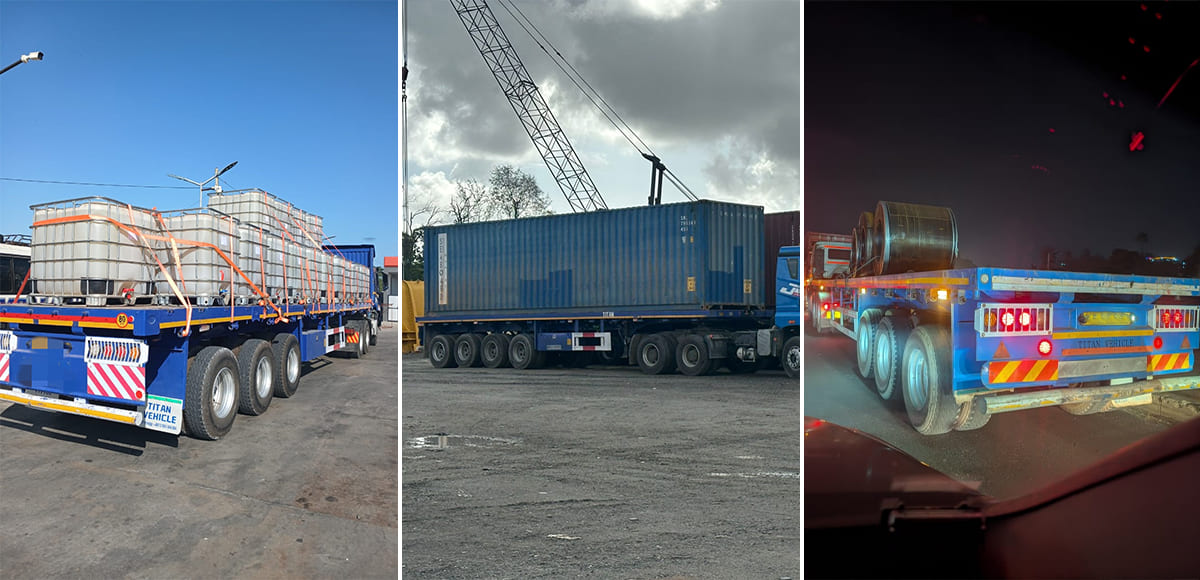
A flatbed should be loaded according to the cargo's dimensions, weight, center of gravity, and securing requirements. Heavy cargo should not simply be placed wherever there is available deck space. Concentrating a large amount of weight in one location can create a different structural and axle-loading condition from evenly distributed cargo.
For containers, the process is more structured because the supplied trailers use 12 container locks. The container should be positioned over the designated locking points and the required locking devices should be properly engaged before transportation.
For general cargo, the securing method depends on the cargo. Chains, straps, blocks, or other appropriate restraint systems may be required according to the cargo characteristics and operating conditions.
The open deck also affects the practical loading process. Forklift access, crane clearance, cargo length, cargo width, and available working space at the loading location all influence how the load can be positioned. Therefore, a flatbed trailer for sale should be viewed as an open cargo platform combined with a structural load-bearing system, rather than simply as a flat surface.
5.2 What Should Nigerian Buyers Check Before Ordering?
The first consideration is the intended cargo and maximum operating weight. A fleet that mainly handles containers may have a different requirement from a fleet transporting heavy industrial components. The trailer should therefore be selected according to actual cargo patterns.
The second consideration is the structural specification behind the flatbed trailer price. For the supplied products, the difference between the 3-axle and 4-axle configurations includes not only axle arrangement but also main beam thickness and side structure. The buyer should confirm exactly which configuration is included in the quotation.
The third consideration is tractor compatibility. The supplied trailer uses a 50 mm kingpin, so the tractor's fifth-wheel system should be compatible. The braking and electrical systems should also be checked against the tractor configuration used by the fleet.
The fourth consideration is the final technical document. Because the supplied 4-axle information contains a conflicting axle reference, the final document should clearly state the actual axle quantity, axle rating, brake configuration, tire specification, and other critical components before production.
5.3 What Makes One Supplier Better Than Another?
A supplier comparison should focus on specification clarity and manufacturing consistency rather than only the lowest flatbed trailer for sale price. For B2B buyers, the supplier should be able to clearly identify the main beam dimensions, steel material, deck structure, side members, axle arrangement, tires, suspension, braking system, kingpin, container locks, electrical equipment, and reinforcement. This level of information makes it easier to compare two quotations on an equivalent basis.
The stated manufacturing specification for these trailers also includes powder coating and baking, together with waterproof electrical cables. These details should remain consistent with the confirmed production specification. For a Nigerian buyer, the final procurement document should therefore describe the exact trailer being purchased instead of relying only on a general product title such as “heavy-duty flatbed.” The practical value of a flatbed trailer for sale is determined by the relationship between its structural design and the customer's operating requirement.
5.4 Is a Flatbed Trailer a Good Choice for Nigeria?
A flatbed trailer for sale in Nigeria can be a practical option when the intended cargo can be safely transported on an open platform. The supplied 12,500 × 2,500 × 1,530 mm configuration and 12 container locks make the product particularly relevant to container and general cargo applications. A flatbed is not automatically the correct trailer for every heavy cargo application, and choosing the highest stated capacity does not eliminate the need to check cargo dimensions, load distribution, securing requirements, tractor compatibility, and the final technical configuration.
For a Nigerian fleet operating more than one cargo category, it can also be useful to treat different trailer configurations as different tools rather than attempting to make a single configuration perform every transport task. The decision should ultimately connect three things: the cargo, the structural specification, and the operating requirement.
 Flatbed Trailer for Sale in Nigeria | Flatbed Trailer Price, Specifications
6.1 What Are Flatbed Trailers?
A flatbed trailer is an open semi-trailer with a level cargo deck and no fixed enclosed cargo body. It can be used for containers, machinery, steel products, construction materials, industrial components, and other cargo that can be safely loaded onto an open platform.
For a buyer searching for a flatbed trailer for sale, the main advantage is loading flexibility. Cargo can potentially be loaded from the rear, side, or above depending on the equipment and site conditions. For buyers searching specifically for a flatbed trailer for sale in Nigeria, the correct configuration should still be selected according to cargo weight, dimensions, and securing requirements.
6.2 What Is the Difference Between a Lowbed and a Flatbed?
A flatbed provides a relatively level open platform for general cargo and container transportation.A lowbed uses a lower deck arrangement and is intended for applications where deck height and overall transport height are important, such as certain oversized or high-profile heavy equipment.
Therefore, the difference is mainly functional. A buyer looking at flatbed trailer prices should compare the trailer against the transport problem it is intended to solve rather than comparing the two products simply as alternative trailer types.
6.3 How Much Weight Can a Flatbed Trailer Carry?
The supplied 3-axle configuration is specified around a 60-ton load requirement, while the supplied 4-axle configuration is specified around an 80-ton load requirement. These figures apply to the specific configurations provided and should not be treated as a universal capacity for every flatbed trailer for sale.
Actual operating suitability depends on the complete trailer and tractor configuration, including frame construction, axles, suspension, tires, brakes, cargo distribution, and final technical specifications.
6.4 What Is the Size of a Flatbed Trailer?
The two supplied configurations have an overall size of 12,500 × 2,500 × 1,530 mm. They are designed as 40-foot-class flatbed configurations for container and general cargo applications. Although they may be described as 40-foot flatbeds because of their intended container use, the actual overall length is approximately 41 feet. A buyer should therefore confirm the exact millimeter dimensions when reviewing a flatbed trailer for sale in Nigeria.
6.5 How Do You Load a Flatbed Trailer?
Loading depends on the cargo type, weight, dimensions, center of gravity, and securing requirements. For containers, the supplied trailers use 12 container locks, allowing the container to be positioned at designated locking points. General cargo requires an appropriate securing arrangement based on the characteristics of the load. The open deck provides loading flexibility, but it does not remove the need for correct load distribution and restraint.
6.6 Which Flatbed Trailer Is Suitable for My Application?
The appropriate flatbed trailer for sale depends on the actual cargo requirement. The supplied 3-axle model is configured around a 60-ton requirement, while the 4-axle model is configured around an 80-ton requirement and uses heavier main beam and side-member specifications. The decision should therefore be based on actual cargo weight and operating conditions rather than choosing a model solely because its flatbed trailer price is lower or its capacity number is higher.
6.7 What Should I Check When Buying a Flatbed Trailer For Sale?
Before placing an order, check the overall dimensions, stated load requirement, main beam construction, steel specification, side members, cross members, axle configuration, tires, suspension, brakes, kingpin, container locks, electrical system, reinforcement, and final technical drawing. The quoted flatbed trailer price should be compared only after confirming that the specifications are equivalent.
For a buyer looking for a flatbed trailer for sale in Nigeria, the final order should clearly identify the exact configuration and components being supplied. This is especially important for the supplied 4-axle specification, where the axle description should be confirmed against the final production drawing before manufacturing.
 Flatbed Trailer for Sale in Nigeria | Flatbed Trailer Price, Specifications
Add: PLOT 3, OBA, AKRAN AVENUE, IKEJA, LAGOS